Thursday, 31 March 2011

Environmental disaster looms at Nightingale Island.

Bulk carrier ‘Oliva’ breaks up, crew rescued.
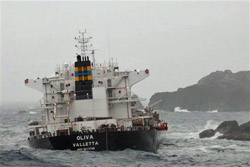


Oil from the stricken bulk carrier ‘Oliva’ has spread up to eight miles around the entire uninhabited Nightingale island of the Tristan da Cunha Group, threatening ecological calamity. Awful scenes are reported; the group of islands is home to some 20,000 northern rockhopper penguins- about half the world’s population and the most threatened species of penguin- hundreds of which have been already found coming ashore coated with oil. Transport Malta says it is investigating the grounding and subsequent complete hull failure of the Malta-registered 40,170 gross tonnage bulk carrier. All the 22 crew aboard were safely evacuated before the Oliva broke up.

The ship was on a voyage from Brazil to Singapore with 65,000 tonnes of soya beans and around 1500 tonnes of fuel oil when she ran aground off the remote islands on March 16, 1500 miles from South Africa in the South Atlantic. Her fuel tanks are ruptured and are leaking oil into the sea. Environmentalists are extremely concerned that the leaking oil and cargo- and any rats on the ship that may get ashore- will irretrievably decimate the penguins, the rock lobster fisheries and the internationally-important seabird colonies there.


As an immediate response, the Tristan Conservation Department has placed baited rodent traps ashore near where the Oliva grounded and a salvage tug, the Smit Amandla, is reportedly on the scene now, having travelled 1500 miles from Cape Town with an environmental expert aboard. A second vessel is due to follow. Sadly, this small group of islands is incredibly remote, with the nearest landmass 1500 miles away and only accessible after a 4-7 day voyage by sea; there is not even an airstrip there. Local authorities say that tens of thousands of penguins and seabirds will be affected, and a superhuman endeavour would be needed to address the disaster.

Biologist Richard Cuthbert from RSPB, Europe’s largest conservative charity, is angry: "How a modern and fully-laden cargo vessel can sail straight into an island beggars belief. The consequences of this wreck could be potentially disastrous for wildlife and the fishery-based economy of these remote islands. The Tristan da Cunha islands, especially Nightingale and adjacent Middle Island, hold millions of nesting seabirds as well as four out of every ten of the world population of the globally endangered Northern rockhopper penguins. Over 200,000 penguins are currently on the islands and these birds will be heavily impacted by leaking oil. Nightingale is one of two large islands in the Tristan da Cunha group that are rodent-free. If rats gain a foothold their impact would be devastating”.

Trevor Glass, the on-scene Tristan Conservation Officer, is more direct. “The scene at Nightingale is dreadful as there is an oil slick around the entire island. The Tristan Conservation Team are doing all that they can to clean up the penguins that are currently coming ashore. It is a disaster!"


ITF collective crew agreement extends piracy High Risk Areas.

With pirate attacks escalating and becoming more violent in a broad swath of the Indian Ocean and the Arabian Sea, the Joint Negotiating Group (JNG) and the International Transport Workers Federation (ITF) agreed at a London meeting two days ago to revise the International Bargaining Forum (IBF) High Risk Areas (HRA) in the Gulf of Aden and Indian Ocean.


ITF agreements apply to Flags of Convenience and normally set out terms and conditions of seafarer employment. The ITF has earlier declared that it believes that ships should only transit the Gulf of Aden and the coast of Somalia in exceptional circumstances. The risk of attack is now so great, the organisation said, ‘that putting seafarers in harm’s way amounts to a breach of the shipowner’s duty of care’.

The application of the new Extended Risk Zone, which covers almost the entire Arabian Sea (see map) and a large part of the Indian Ocean, will commence from April 1. Vessels will have to provide increased security measures within this zone that will be above the latest Best Management Practice levels promulgated. These may include- depending on the vessel’s size, speed, freeboard and other factors- provisions of personnel or systems to reduce the vulnerability of the ship during HRA transit. The adoption of the Best Management Practices will be a minimum standard of protection under the IBF, it was confirmed at the meeting.

As before, seafarers shall still be entitled to compensation amounting to 100% of their basic wages during any HRA transit, with double compensation in case of death or disability. In case vessels plan to transit the IBF High Risk Area outside of the east bound and west bound lanes created under the International Recommended Transit Corridor, seafarers have the right to refuse to proceed with the passage and will be repatriated at the company’s cost. “This entitlement shall only apply in respect of vessels which are bound to enter the IBF High Risk Area, and will not apply in case of crossing the rest of the Extended Risk Zone”, says the IBF agreement.

Outside the High Risk Area, each seafarer shall be entitled to a bonus equal to 100% of the basic wage and a doubled compensation in case of injury or death on any day during which the vessel he serving on is attacked, provided the report of the attack has been made to international authorities like the UKMTO and proper log entries made. The IBF agreement defines ‘attack’ as ‘any unauthorised and obvious action taken by a third party in a wilful attempt to board or damage the vessel or to harm the crew which leads to the activation of the relevant vessel contingency plans including the alerting of the whole crew’.

No compensation will be payable when ships are alongside, at anchor, or tied up to SBMs, except in Somali ports.
.

.

Radiation fears see some ships avoiding Tokyo Bay ports.

As radiation fears rise after the near meltdown at the Fukushima nuclear plant after the March 11 earthquake off Japan, some companies- particularly German companies- are now not sending their ships to the Tokyo Bay area. Reports say that Japan could face ‘severe supply chain bottlenecks’ if ships are diverted. Reuters reports that companies like Hapag Lloyd- the world’s fifth largest container shipper- and Claus Peter Offen are amongst those avoiding the area. Ships are also not calling Yokohama. "We don't want to take any security risks," a Hapag-Lloyd spokesperson said yesterday. Shipping company Hamburg Sued has resumed calls to Tokyo and Yokohama after stopping them for a day. "We are looking very closely at the weather situation," a company spokeswoman said.


The German government has recommended that ships stay about sixty miles away from the Fukushima nuclear plant area to avoid radiation exposure to crews. Offen points out that radioactive contamination of a container ship and its load were not covered by insurance. Analysts warn that logistical issues due to these developments would result in delays and port congestion that could have a significant negative impact on Japanese recovery after the earthquake that devastated parts of the country two weeks ago. Says Tim Wickmann, CEO of MCC Transport, an A.P. Moller Maersk subsidiary, "The last thing Japan needs right now is for people to abandon them." He added, "I think that shippers around Asia in such case will stop their cargoes to eastern Japan. They will hold the cargo at various ports -- Korea, Taiwan or other nearby ports." Such a move would see container shipments to eastern Japan come to a halt.

MCC Transport has continued normal operations so far. "As long as the authorities consider the port safe, we want to go. But of course if you have a crew that refuses to sail the ship, what can you do?" asked Wickmann.


Fears in Tokyo rose sharply earlier this week after the Japanese government advised its 13 million residents not to give infants tap water. The world’s third largest economy is still coming to grips with the aftermath of the disaster; although experts say that the situation at Fukushima seems to be contained for now, many expats and locals have either been evacuated from the country or have moved from Tokyo to safer areas in the south.

Fifteen Japanese ports were severely damaged in the earthquake and tsunami. Twelve of those ports “were already usable for recovery efforts and general use”, the Japanese transport minister said recently. Shipping agent Inchcape says that most of Japan’s oil terminals remain open, except for those at Kashima, Onahama, Sendai and one partially operational one at Chiba.

That may be so, but normal crude and product trades have nonetheless been severely disrupted. Tanker owners are waiting and watching anxiously. The fluid situation in Japan- not to speak of the Libyan and Middle Eastern crises- is no doubt giving many of them sleepless nights.
.


.


Monday, 21 March 2011

Snippets

11 year old pirates amongst 25 child pirates captured, say Indian authorities.


The Indian Navy, that had detained 61 pirates in an operation in the Arabian Sea in the first week of March, was amazed to find the 25 of the 61 claimed to be less than 15 years old. "At least four of them are just 11 or so. It seems younger and younger children in Somalia are being pushed into piracy, which is proving immensely lucrative in the lawless country-the established pirates, who have got rich, are no longer sailing out on raids," a spokesman told reporters.

This development comes even as the Indian authorities announced recently that modifications to the navy’s rules of engagement were on the anvil that would give the forces more teeth to aggressively pursue and engage pirates off the country’s coast. Teenage pirates have been often detained by navies, including the Indian navy, but this is the first time that so many children below 15 have been caught.

All the arrested pirates have been taken to the Yellow Gate police station in south Mumbai, and will be charged under appropriate laws, authorities say. The issue of child pirates, however, will undoubtedly make the prosecution of captured pirates even more complex. Experts point out that the legal system will be surely stymied by the fact that so many of the pirates are children. They say that a parallel can be drawn between these child pirates and child soldiers that are dismayingly common around the world- particularly in Sierra Leone’s ‘blood diamonds’ trade, the Sudanese civil war and the Afghan and Iraq conflicts.


Naked adventurer seeks world record.

Thirty year old Keith Whelan from Kildare in Ireland intends to become the youngest male rower and the first Irishman to cross the Indian Ocean. An interesting addition: he will be completely naked- and sitting of a sheep skin rug- when he makes the 6000 mile voyage from Australia to Mauritius.

To quickly add: Mr Whelan is not planning the nude crossing to seek publicity; he told the media that he was doing this to protect himself from the harsh elements and the hostile environment. "When you're at sea rowing for three and a half to four months, the salt gets encrusted in your clothes and you can't wash them," he said. "Eventually, your clothes will feel like you're wearing sandpaper and you will begin to chafe."

He may have a point. Rowing 12 hours daily on a two hour on- two hour off rotation, he will take four months to make the crossing, making an estimated 1.8 million oar strokes “in searing heat, up to 50 foot ocean swells, hurricane force winds and raging storms”, and on a boat just 23 feet long.

He is also raising funds for the Keep a Child Alive charity, which gives life-saving treatment, care and support to children and families affected by HIV/Aids in Africa and India.

An event management consultant, Mr Whelan started rowing just two years ago, but says that he always wanted to make this gruelling voyage. "More people have walked on the moon than have rowed across the Indian Ocean. I'm hoping to get the spotlight of achievement back on Ireland with this world record."
.


.

Thursday, 17 March 2011

New policy framework to tackle pirates, says External Affairs Minister

Indian ships to carry arms?


The Indian government has initiated wide ranging changes to the existing policy framework in order to take on the deepening Somali pirate crisis. Prompted no doubt by media attention and the tumult in Parliament recently over the plight of Indian seafarers held hostage on ships and in Somalia, the authorities have announced the formulation of broad based measures, from tweaking laws to giving the Indian navy new rules of engagement- even letting Indian merchant ships carry arms. Minister for External Affairs S M Krishna made a statement in the Lok Sabha yesterday saying that the Ministries of Shipping, External Affairs and Defence would address the “legal, administrative and operational aspects of combating piracy.” He also underlined that the government would increase “diplomatic efforts at the multilateral level and within the UN framework.”


An inter-ministerial group headed by the cabinet secretary would monitor release of Indian ships, crew or cargo hijacked by pirates, Krishna added, saying that this apex group would also “consider welfare measures necessitated after the release of hijacked Indian nationals”.


Krishna’s statement was made soon after the Cabinet Committee on Security (CCS) met in New Delhi under PM Manmohan Singh. With 53 Indians officially held hostage in Somalia on five ships- unofficial numbers are higher- the CCS is reported to have approved measures that include new aggressive Standard Operating Procedures for the Indian navy that widen the scope of its offensive operations, allowing Indian flagships to carry weapons and better military and diplomatic coordination with countries around the Indian Ocean rim. The Navy is set to be authorised to act if any Indian flagship or a ship with Indians aboard is attacked. A crisis management group will be setup to coordinate with all groups, including the families of seafarers held hostage.


The government does not see a role for itself in negotiating with pirates, the External Minister stressed. However, an official speaking later to the media pointed out that authorities would “bring a lot of pressure to bear” on shipping companies that have been the target of pirates in the region.


India does not have an exclusive law that deals with piracy. Opinions are divided amongst politicians on the way forward, with Leader of Opposition Sushma Swaraj saying that UN mechanisms on piracy should be used to tackle the menace. However, the government is said to be concerned that pirates, suspected to be involved with terrorist outfits, may pose a significant threat to the Indian coastline, shipping and cargo- 90% of the country’s trade moves by sea.


Experts have expressed some disquiet about the navy’s new rules of engagement, saying that a more aggressive stance taken after pirates have boarded a ship may needlessly jeopardise the lives of seafarers. They point to recent instances of hostages being killed in crossfire between coalition navies and pirates, who are more willing today to execute and torture captive sailors or use them as human shields. Finally, they point out that enforcing domestic legislation in international waters against pirates is a thorny issue that many countries have been struggling with for years.